
Table Of Contents
A boost converter is a power electronic device that increases the input voltage to the output voltage. Its operating principle is based on inductive energy storage and switch control, making it a common and important power converter.
Working principle of boost converter
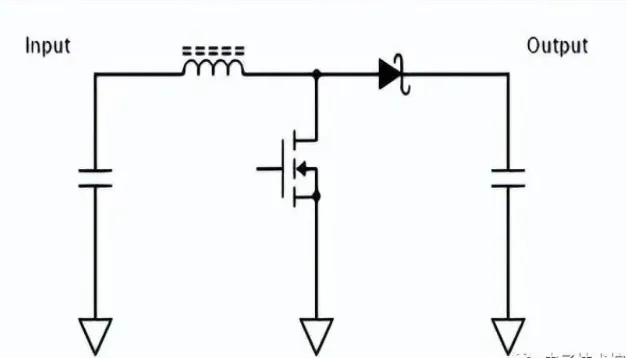
The boost converter consists of an input power supply, a switch tube, an inductor, a capacitor, a diode, and a load. Its basic working principle is as follows.
The switch tube is turned on. When the switch tube is turned on, the input power supply voltage is transferred to the capacitor through the inductor and the switch tube, and the inductor accumulates energy.
When the switch tube is turned off: If the switch tube is turned off, the upper and lower voltages of the capacitor are reversed due to the change in the polarity of the inductor, and the output voltage is also reversed, which can provide an improvement effect.
The diode is turned on: When the switch tube is turned off, the diode is turned on, and the capacitor discharges to the load through the diode to provide output current.
By sequentially turning on and off the switch and the diode, the boost converter can control the output voltage by adjusting the ratio of the on and off time. Generally speaking, increasing the on time ratio will increase the output voltage, while reducing the on time ratio will reduce the output voltage.
Advantages of Boost Converter
The boost converter has the following advantages:
Wide power supply voltage range: The boost converter can operate in a wide input voltage range from a few volts to tens of volts to meet the requirements of various applications.
Provide efficient power conversion: The boost converter can store energy through inductance, reduce energy loss, achieve efficient power conversion, and provide higher output voltage when the input voltage is low.
Simple structure and small size: The boost converter has a simple structure and generally requires a small number of parts to implement, so it is small in size and light in weight, suitable for use in a variety of electronic devices.
Output stability: The boost converter can control the on-time ratio to keep the output voltage close to the set value and have good stability.

Application of boost converter
Boost converters are widely used in various fields, such as:
Electronic devices: Boost converters are used in mobile electronic devices such as mobile phones, tablets and laptops to increase the battery voltage to meet the power supply needs of various components.
Renewable energy: Boost converters are also widely used in renewable energy systems such as solar and wind power to convert low-voltage renewable energy to high voltage, suitable for grid-connected or energy storage systems.
Wireless communication: Boost converters are used in wireless communication systems to convert the low voltage powered by the battery to the high voltage provided by the wireless module for signal amplification, RF transmission, etc.
Industrial control: Boost converters are also widely used in industrial control equipment, such as upgrading low-voltage PLC systems to high voltage to match the control and transmission of other equipment.
Medical equipment: Boost converters are also used in medical equipment to provide appropriate output voltage to power patient monitors, electrocardiograms, blood pressure monitors and other equipment.

To sum up, the working principle of the boost converter is simple but powerful and it is widely used in various fields. Its high efficiency, stability, and small size make it one of the indispensable power converters in today’s electronic equipment.