

Table Of Contents
Switching power conversion has been a mainstay of modern electronics for many years, spanning multiple sectors including the utility, industrial, commercial, and consumer markets. In low-power DC-DC conversion applications, most modern power conversion is accomplished using three different types of power converters: boost, buck, and buck-boost converters. This article will analyze the basic principles of each converter and explore practical applications.
A buck converter is a DC-DC switching power supply that steps down an unregulated DC input voltage to a stable low output voltage. Buck converters are widely valued because of their higher efficiency compared to traditional voltage regulators, which can easily exceed 95%. The current path during the buck converter switching period can be seen from the simple circuit diagram below
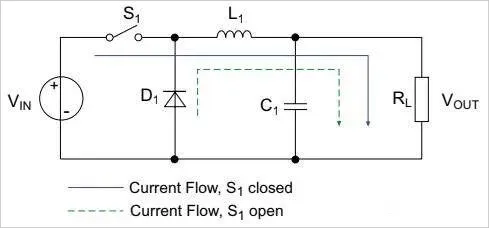
Buck converters are usually required to convert a higher input voltage into a lower output voltage, replacing traditional inefficient linear regulators. They are also widely used in various consumer and industrial applications. Existing buck converters are very efficient and can produce well-regulated output voltages under conditions of a wide range of input voltages and output loads.
So what is a boost converter?
A boost converter is a DC/DC switching power supply that boosts an unregulated DC input voltage to a higher regulated output voltage. Similar to a buck converter, a boost converter relies on an inductor, diode, capacitor, and switch to regulate the output voltage, but the difference is in how they are configured. The simplified circuit diagram below shows the current path during the switching of a boost converter.
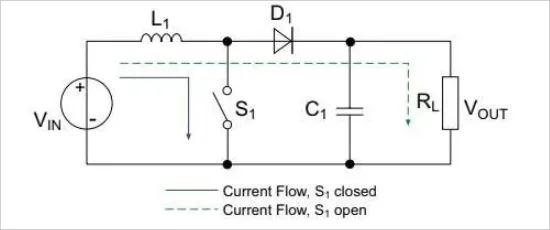
In a boost converter, the output voltage varies according to the ratio of the conducting switches of the PWM signal, equal to or greater than the input voltage. Because of the power savings, a boost converter that provides three times the input voltage can only provide one-third of the current. But boost converters are very common in battery-powered devices, such as a set of 3V battery voltage to power a 5V circuit.
The buck-boost converter can step up or step down the input DC voltage to obtain a stable DC output voltage. Its working principle is a combination of the working modes of the buck and boost converters. When the input voltage is higher than the output voltage, the buck-boost converter works in buck mode; when the input voltage is lower than the output voltage, the buck-boost converter works in boost mode. By controlling the on and off time of the switch tube, the buck-boost converter can achieve the buck-boost conversion of the input voltage, and filter and stabilize the voltage through components such as inductors, capacitors and diodes to obtain a stable DC output voltage. The simplified circuit diagram below shows the common current path during the switching of the buck-boost converter.
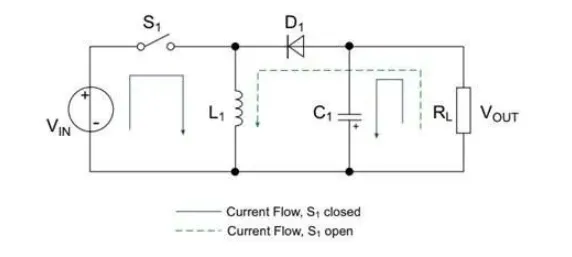
Buck, boost and buck-boost converter technologies are widely used in the world and can be found in almost every electronics market providing low voltage regulated DC/DC power supplies. IDEALPLUSING’s buck, boost and buck-boost converters are the solution to meet your low power conversion needs.